Let be a function defined on an open interval containing . A number in the domain of () is called a critical number (or critical value of the independent variable) if:
Concept Explanation
1. The Anatomy of a Critical Number
Locating the critical numbers of a function is the foundational first step of differential optimization. Every local peak, local valley, or sharp turning point must occur at a critical number.
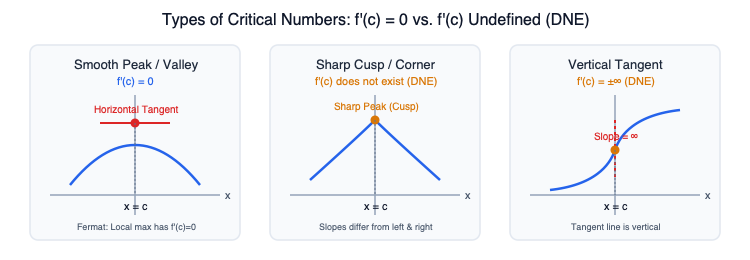
Critical numbers manifest in two distinct mathematical ways:
- Stationary Points (): The tangent line to the curve at is perfectly horizontal. The instantaneous rate of change temporarily halts. Examples include smooth peaks, smooth troughs, and horizontal inflection plateaus (such as at ).
- Singular Points (): The derivative fails to exist at , yet remains a valid point within the function's domain. Examples include:
- Sharp Corners: Left-hand and right-hand slopes approach different finite values (e.g., at ).
- Sharp Cusps: Slopes approach infinite values of opposite signs (e.g., at , where ).
- Vertical Tangents: Slopes approach or from both sides (e.g., at ).
2. Fermat's Theorem and the Converse Trap
Fermat's Theorem on Local Extrema states:
If has a local extremum (local maximum or local minimum) at , and if exists, then .
Fermat's Theorem guarantees that local extrema only occur at critical numbers. However, the converse is FALSE: A critical number does NOT guarantee the existence of a local extremum!
- Counterexample: Consider . Its derivative is . Setting yields , so is a valid critical number. However, is strictly increasing across all real numbers ( for , and for ). The point is an inflection terrace, neither a local maximum nor a local minimum.
- To determine whether a critical number actually generates an extremum, one must apply the First Derivative Test or Second Derivative Test.
3. The Crucial Domain Restriction Rule
A number can only be classified as a critical number if it belongs to the domain of the original function :
- The Rational Function Trap: Consider . Its derivative is . At , the derivative is undefined. However, is NOT a critical number because is not in the domain of (it is a vertical asymptote).
- The Logarithmic Function Trap: For , . While is undefined at , , so is not a critical number.
Engineering Applications
- Mechanical Cam and Follower Profiling: In internal combustion engines and automated packaging machines, cam lobes are engineered with specific lift profiles . Critical points where define the valve dwell angles—instants of zero velocity where the intake or exhaust valve remains fully open to maximize airflow.
- Electrical Circuit Transient Response: In RLC filter circuits, the instantaneous capacitor voltage following a switching transient contains critical numbers where . Electrical engineers calculate these critical points to determine the exact peak overshoot voltage and prevent dielectric insulation breakdown in semiconductor components.
- Structural Load Deflection: In civil structural beams, points of zero slope in the deflection curve identify the maximum beam sag under distributed dead weight, dictating where reinforcement tendons must be anchored.
Example Problems
Example 1: Critical Numbers of a Polynomial Function
Find all critical numbers of the polynomial function:
Solution
- Identify the Domain: As a polynomial, the domain of is all real numbers, .
- Differentiate:
- Solve for Stationary Points ():
Factor out the greatest common factor:
Setting each linear factor to zero yields:
- Check Singular Points (): Since is a polynomial, it is defined everywhere; there are no singular points.
- Conclusion: The critical numbers are and .
Example 2: Critical Numbers with Singular Points (Cusps)
Find all critical numbers of the function:
Solution
- Identify the Domain: The expression involves an odd root (cube root), which is defined for all real numbers. Thus, .
- Differentiate:
Using the Power Rule and Chain Rule:
- Solve for Stationary Points (): A fraction equals zero only when its numerator is zero. The numerator is . Therefore, for all .
- Solve for Singular Points ():
The derivative is undefined when the denominator equals zero:
Because is in the domain of (), is a valid critical number.
- Conclusion: The function has exactly one critical number at (representing a sharp cusp peak on the graph).
Example 3: Rational Function and the Domain Trap
Find all critical numbers of:
Solution
- Identify the Domain: The denominator cannot be zero: . Domain: .
- Differentiate via Quotient Rule:
- Stationary Points ():
Set numerator to zero:
Both and are in the domain of .
- Singular Points (): The derivative is undefined when . However, is NOT in the domain of ( is undefined; the graph has a vertical asymptote at ).
- Conclusion: The critical numbers are strictly and . ( is excluded).
Connections & References
- Parent Concept: Definition of the Derivative
- Sub-Concepts & Theorems:
- Course Sessions: