MATH-283 (Calculus III) Curriculum
Session 02 - Vectors in 2D and 3D
By the end of this session, you will be able to:
- Plot coordinates and calculate distances/equations of spheres in a 3D rectangular coordinate system.
- Represent vectors in component form and unit-vector notation in 2D and 3D, and calculate their magnitudes and directions.
- Perform vector operations (addition, subtraction, scalar multiplication, unit vectors) and apply them to model physical systems in static equilibrium.
Micro-Lecture
1. 3D Coordinates & Spatial Geometry
- Mathematical Foundation: In the three-dimensional rectangular coordinate system, points are represented as ordered triples . The distance between two points and is . A sphere centered at with radius is described by the equation .
- Engineering Context: Necessary for mapping physical assets in 3D space, coordinate transformations in robotics, modeling spherical blast ranges, and structural piping designs.
2. Vectors and Unit Vector Notation
- Mathematical Foundation: A vector represents a directed line segment with component form or standard unit vector form . The magnitude is . A unit vector in the direction of is , which has a magnitude of 1.
- Engineering Context: Used to define directional loads on joints in CAD modeling, velocity fields in aerodynamics, and electric fields in power systems.
3. Vector Arithmetic & Static Equilibrium
- Mathematical Foundation: Vector addition and scalar multiplication are performed component-wise. Under static equilibrium conditions, the net external force vector acting on a point-mass is zero: , which requires the horizontal and vertical components to independently sum to zero.
- Engineering Context: Crucial for calculating tension loads in support cables, resolving wind loads on structures, and structural analysis of crane supports.
Skill Block 1
Worked Example A: Distance in 3D
Calculate the distance between the two points and .
- Identify Coordinates: Let and .
- Apply Distance Formula:
- Simplify:
Worked Example B: Equation of a Sphere
Find the standard equation of the sphere centered at with a radius of .
- Identify the Center and Radius: and .
- Substitute into standard form:
- Simplify:
Worked Example C: Center and Radius of a Sphere
Find the center and radius of the sphere defined by the equation .
- Group Variable Terms:
- Complete the Square for Each Variable:
(Note: Refer to Completing the Square for a detailed refresher on this algebraic technique.)
- For : add
- For : add
- For : add
Add these values to both sides of the equation:
- Write in Standard Form:
The center is and the radius is .
Practice Problem 1: Concept & Reading Check
Open this Skill Block on the Memex to locate the information needed to answer the following:
- (a) Under the Conceptual Framework section, describe the Right-Hand Rule and how it determines the positive -axis.
- (b) Look at the Key Equations & Structural Rules section. What is the standard form equation of a sphere with center and radius ?
- (c) Trace Worked Example C. Why is the algebraic technique "Completing the Square" used to rewrite the sphere's equation? What values were added to both sides of the equation?
- (a) As outlined in the Conceptual Framework section, the Right-Hand Rule establishes the 3D coordinate orientation. Pointing your right index finger along positive and curling your fingers to positive leaves your thumb pointing along the positive -axis.
- (b) According to the Key Equations & Structural Rules section, the standard equation of a sphere is , where is the center coordinate and is the radius.
- (c) Tracing Worked Example C, the given equation is . Completing the square groups the quadratic and linear terms for each variable to rewrite them in standard squared form. To balance the equation, we add for , for , and for to both sides, transforming the constants on the right side to .
Practice Problem 2
Label the axes in the coordinate system below according to the right-hand rule, and plot the points , , and .
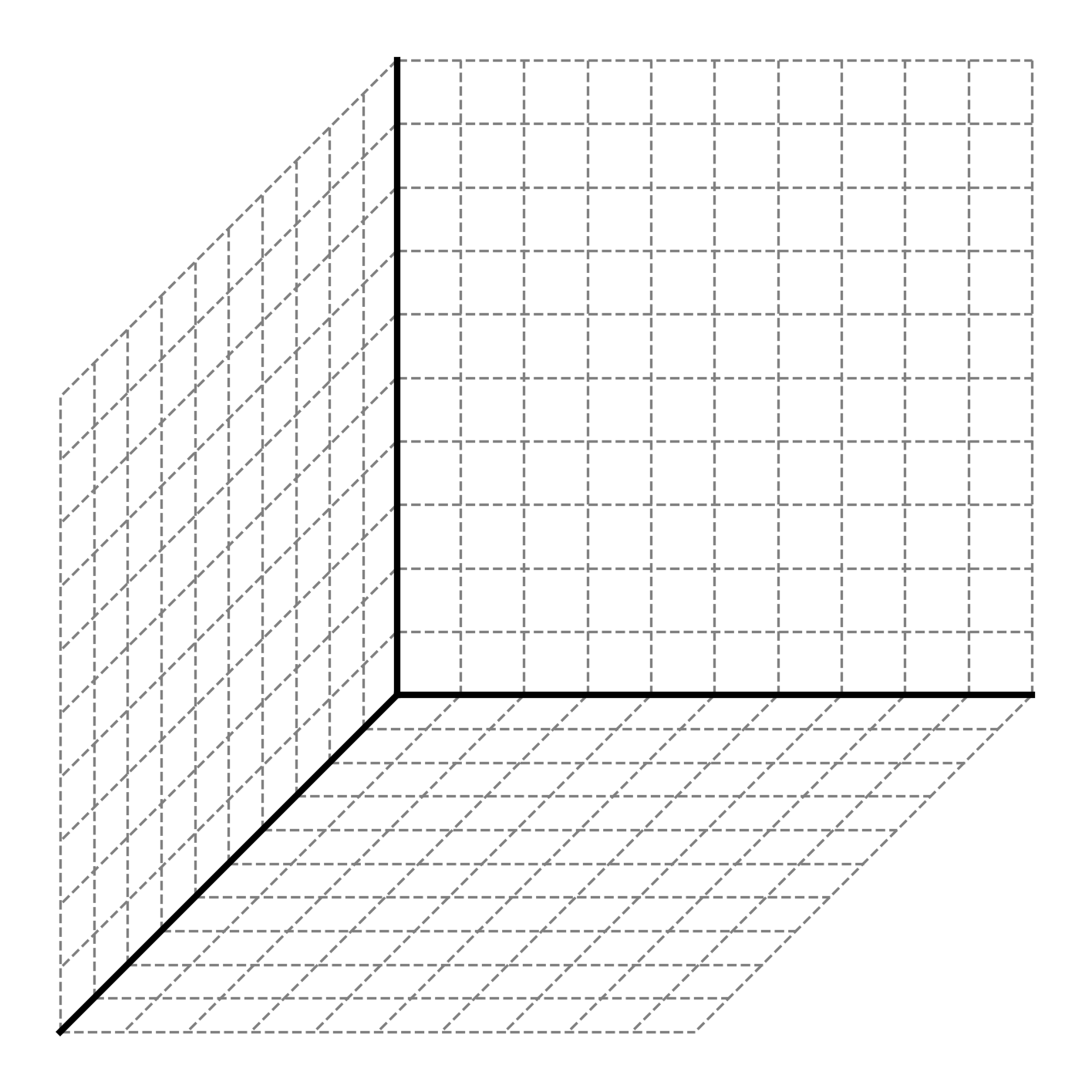
- Establish the Axes: Following the standard convention for the right-hand rule:
- The -axis points diagonally forward and to the left.
- The -axis points horizontally to the right.
- The -axis points vertically upward.
- Plot Point A (5, -4, 0):
- Move units forward along the positive -axis.
- Move units parallel to the negative -axis (to the left).
- Since the -coordinate is , the point lies directly on the -plane.
- Plot Point B (0, 3, 0):
- The - and -coordinates are .
- Move units to the right along the positive -axis.
- Plot Point C (1, 3, 2):
- Move unit forward along the positive -axis.
- Move units to the right parallel to the positive -axis.
- Move units upward parallel to the positive -axis.
Practice Problem 3
Determine if the equation represents a sphere. If it does, find its center and radius.
- Group terms:
- Complete the square:
(Apply the Completing the Square technique to each variable):
- For : add
- For : add
- For : add
Add these to both sides:
- Simplify:
Since the right side is positive (), it is a sphere. Center: Radius:
Regroup 1
- Review coordinate axes orientations and right-hand rule.
- Address common errors in completing the square (e.g. sign errors and forgetting to add terms to both sides).
Skill Block 2
Worked Example A: Vector Components and Magnitude
Given the points and , find the vector starting at and ending at in component form and calculate its magnitude.
- Find components:
Component form: (or unit vector form: ).
- Calculate magnitude:
Worked Example B: 3D Vector Representation
A cable exerts a force of magnitude N along a line pointing from the origin to the point in millimeters. Write the force vector in component form.
- Find the direction vector: Let .
- Compute magnitude of direction vector:
- Find the unit vector:
- Scale unit vector by force magnitude:
Worked Example C: Components from Angle
A vector has magnitude and makes a angle with the positive -axis. Find its horizontal and vertical components.
- Apply trigonometric formulas:
- Evaluate components:
Component form: .
Practice Problem 4: Concept & Reading Check
Open this Skill Block on the Memex to locate the information needed to answer the following:
- (a) Under the Conceptual Framework section, what is the difference between component form and unit-vector notation for representing a vector in 3D?
- (b) According to the Key Equations & Structural Rules section, what is the formula for calculating a displacement vector from points and ?
- (c) Trace Worked Example B. Explain why we calculate a unit vector first before scaling it by the force magnitude of N.
- (a) As explained in the Conceptual Framework section, a 3D vector can be written in two equivalent notations: component form using bracket notation , or unit-vector notation using the standard coordinate basis vectors .
- (b) According to the Key Equations & Structural Rules section, a displacement vector representing the path from initial point to terminal point is computed by subtracting the coordinates of from : .
- (c) In Worked Example B, the direction of the force is along the vector . Since this direction vector has a magnitude other than 1, we first convert it to a unit vector (which has magnitude 1). Multiplying this unit vector by the force magnitude of N yields a vector that is collinear with but scales the physical force magnitude correctly.
Practice Problem 5
Given the vector :
- Draw the vector starting from the origin.
- Find the magnitude of the vector.
- Draw the Vector:
- Start at the origin .
- Move unit to the right along the -axis.
- Move units down along the -axis.
- Draw an arrow from to the point .
- Compute the Magnitude:
Practice Problem 6
A directional antenna points along a line from to . Write the direction vector in unit-vector notation, and find a unit vector in the same direction.
- Calculate displacement vector:
In unit-vector notation: .
- Compute magnitude:
- Compute unit vector:
Regroup 2
- Differentiate between coordinates of a point and components of a vector .
- Review notation conventions (bold letters vs. arrows , and unit vectors ).
Skill Block 3
Worked Example A: Vector Combinations
Given the vectors and , calculate the vector sum and find the vector .
- Calculate :
- Calculate :
Worked Example B: Resultant Force from Wind and Current
A boat in a river experiences two forces: a river current force kN and a wind thrust force kN. Add the forces to find the resultant force acting on the boat and calculate its magnitude.
- Add components:
(Refer to Combining Forces and Force Components for a review of how to represent and add force vectors component-wise to find their equivalent single resultant force.)
- Calculate magnitude:
Worked Example C: Vector Equations
Consider the vector . Compute the vectors , , and find the unit vector .
- Compute :
- Compute :
- Compute the unit vector :
First, calculate magnitude:
Divide vector by magnitude:
Practice Problem 7: Concept & Reading Check
Open this Skill Block on the Memex to locate the information needed to answer the following:
- (a) Under the Conceptual Framework section, what mathematical condition must be satisfied for a physical system of vectors to be in static equilibrium?
- (b) Look at the Key Equations & Structural Rules section. Write down the equations that represent static equilibrium in component-wise form for 3D space.
- (c) Trace the linked Engineering Application under the Engineering Applications section. How does the concept of static equilibrium apply to the stage lighting system described?
- (a) According to the Conceptual Framework section, static equilibrium requires that a system is in a state of zero net force. Mathematically, the vector sum of all external forces acting on the body must equal the zero vector: .
- (b) As stated in the Key Equations & Structural Rules section, in three-dimensional space, the vector equilibrium condition translates to three independent scalar equations: the sum of the horizontal, vertical, and depth force components must each equal zero (, , ).
- (c) In the linked Engineering Application under "Suspended Stage Lighting", the stage lights represent a stationary mass. By applying static equilibrium, entertainment engineers can calculate the exact tension forces in the supporting cables to ensure they do not exceed safety limits and that the structure remains completely stable.
Practice Problem 8
An offshore oil platform structural support ring is subjected to three cable force vectors: kN, kN, and kN. Find the resultant force vector . Is the ring in static equilibrium?
- Sum the -components:
- Sum the -components:
- Sum the -components:
The resultant force vector is:Since , the support ring is in static equilibrium.
Practice Problem 9
A weight of N is suspended by two cables. Cable A makes an angle of with the horizontal ceiling (pulling up and left), and Cable B makes an angle of with the horizontal ceiling (pulling up and right). Calculate the tension magnitudes and in each cable. (Round to 2 decimal places).
- Decompose the forces into components:
(Use the methods outlined in Force Components to resolve the angled tension vectors into - and -components):
- Cable A:
- Cable B:
- Weight:
- Apply horizontal equilibrium ():
- Apply vertical equilibrium ():
- Substitute into vertical equation:
- Solve for :
Regroup 3
- Review standard free-body diagrams and drawing force vectors head-to-tail.
- Emphasize component-wise decoupling in static equilibrium equations.
Synthesis Wrap-up
- Core takeaways from Session 02 and overview of homework assignment: Vectors in the Plane Vectors in Three Dimensions.